Our Vision for Sustainability Development
The history of viticulture in the Moselle region dates back to the times of Roman rule. Along the river valleys of Saar, Ruwer and Moselle, the Romans established viticulture and created a tradition that is still deeply rooted in the region today.
In 1966 the Bischöfliche Weingüter Trier were established by merging the vineyards and wineries of Bischöfliches Konvikt, Bischöfliches Priesterseminar and Hohe Domkirche. On more than 120 hectares spread over 145 plots in the Saar, Ruwer and Moselle river valleys, we cultivate the heritage of ecclesiastical viticulture. As the successor entity, we see it as our responsibility to continue the winemaking tradition in the present and pre- serve it for future generations.
The diverse global challenges of our time have an impact on the environment, our social life and our business activities. Against this background, we see the transformation of our company into a sustainable winegrowing enterprise as the key to being able to continue our responsibility and fulfil our mission. Our sustainability approach is based on the United Nation’s guiding principles for sus- tainable development 2030. Further information on the topic is available at https://sdgs.un.org/2030agenda
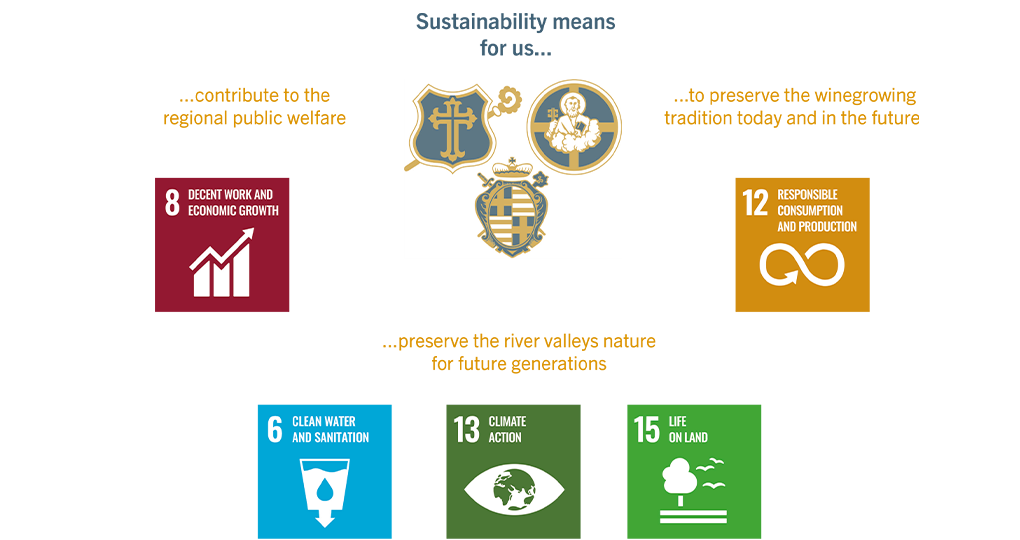
Our business activities have an impact on SDG 6 Clean water and sanitation, SDG 8 De- cent work and economic growth, SDG 12 Sustainable consumption and production pat- terns, SDG 13 Climate action and SDG 15 Life on land. In the following, we as Bischöfliche Weingüter Trier show our responsibility for the topics and the actions we undertake to support the global goals. Please feel free to contact us personally if you have any questions or require more information.
The long version of our mission statement for sustainable development can be downloaded here.